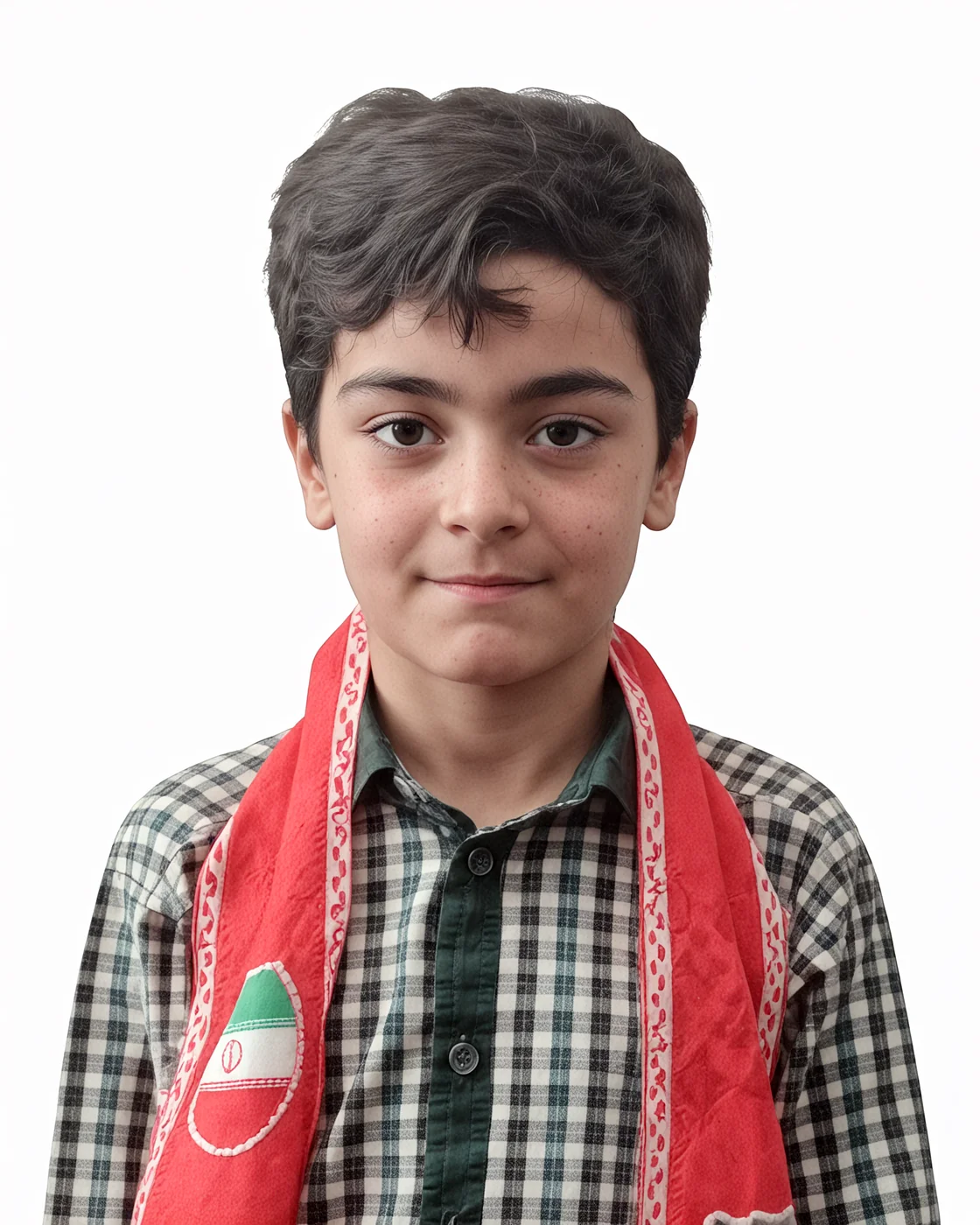
Makan Nasiri was a first-grade student and the only missing victim of this attack. The missile tore apart the fragile body of this beloved child so completely that even after DNA testing on every recovered body part from the attack, nothing of Makan was found.
At 11:16 a.m. on Feb 28, Asiyeh, Makan’s 40-year-old mother, was doing housework when her phone rang. It was Mandana Salari, the first-grade teacher at the school. She asked Asiyeh to come to the school and pick up Makan. Apparently, an attack was underway. Asiyeh, unaware of what was happening and not knowing that Tehran had been struck by missiles hours earlier, called the school transport driver. The driver was near the school and said, “I am going there right now.” The phone was still in Asiyeh’s hand when a massive explosion was heard. The school had been hit by missiles.
Asiyeh and her husband, who happened to be at home at that time of day, got into the car and drove toward Al-Mahdi township, where the school was located. But near the school there was no longer any way forward. They got out of the car and continued on foot. The school was so crowded that Makan’s mother did not know where to go, where to search, or whom to ask: Where was Makan?
A ceremony was held in Minab for Makan and the other students. His sister, Mania, read a text for him from a piece of paper, and everyone’s eyes turned red and tearful. The image of the children’s graves in Minab is the darkest image published: small empty graves that were supposed to be filled with the frail, torn bodies of Minab’s schoolchildren. But Makan’s grave remains empty.
Asiyeh speaks with control and firmness, so much so that one cannot ask her questions about the smallness and innocence of her child. After forty days, her strength for wailing and mourning seems exhausted; it is as though her tears have dried up.
“Many people were under the rubble, but not a single child came out alive. We were there from 11:30 in the morning until 2:30 the next morning. Everyone pulled out from under the rubble was lifeless.”
Makan’s mother cannot speak about the details of searching for her son.
“On the fourth day, Makan’s sweater was found. But I was not sure whether Makan had been wearing the sweater or not, because he usually took it off for sports. That is why I still had hope that he was alive.”
During those 38 days, they went several times to morgues to identify bodies, but they could not identify Makan. DNA samples were also taken from them. Once, they were called to identify a body, but the body was almost frozen, and his mother could not identify it.
“Only Makan’s notebooks and books were found; not his shoes, not his bag, not even a part of his body.”
Shajareh Tayyebeh School was both a girls’ and boys’ school. Before Makan, his sister Mania had studied there for three years. Makan had spent one year in preschool and had been registered for first grade in the new school year. Mania had moved on to seventh grade and gone to another school. Makan’s other brother, Mostafa, who was in tenth grade, was also at another school. On Saturday morning, through the mobile phone, Mostafa learned about the attacks. He asked his teacher for permission to leave school and go bring Makan back, but they did not allow him.
“The girls’ and boys’ yards were separate. The boys’ classrooms on the lower and upper floors had separate routes. The kindergarten was behind the school, along with several girls’ and boys’ classrooms. Fortunately, none of those children were harmed in this attack.”
Makan’s mother had never imagined that anyone would even know Minab, or that, for example, U.S. and Israel could find it on a map. They thought they were living in a very safe area. In the first days after the attack, they learned that Mandana Salari, Makan’s teacher, had been martyred in the same school along with her daughter, who was also a student there.
Hamzeh Rahinejad, Makan’s uncle—the same man who spent 38 days searching for any trace of his nephew—is in another state altogether. Everything that has happened to him since Feb 28 is still fixed in his eyes. He says that from the second day, they formed a team of about twenty people. Uncles and their children went to the site to find some sign of Makan, searching even as far as the wooded area. They imagined that perhaps Makan had been frightened and had run toward the garden area full of trees. Perhaps he had been injured, and no one knew where he was.
Hamzeh says:
“In the end, I went there with a box full of bags and single shoes. I told Asiyeh, ‘Which one of these belongs to Makan?’”
She fainted, because until that day they had seen no trace of Makan. The house was full of people. Everyone had gathered there, and when I arrived and showed them, it was like the Day of Judgment. That day was a real catastrophe.
Hamzeh says his heart had no peace or rest. He was desperate to find some traces of Makan. When Makan’s single shoe was found, they understood that he was one of the school’s martyred students. Hamzeh is from Minab, and his house is not far from the school. When he heard the explosion, even the windows of his house shook. He was frightened and drove toward the school. He abandoned the car halfway, unlocked. From a distance, the smell of smoke, dust, and burning filled the air. From that moment until five o’clock the next morning, he stayed at the site, searching for some signs of their child. But every time they lifted the rubble, what they found were pieces of children’s small hands, feet, and heads.
“It was something strange and unimaginable. It cannot be described. It was very bad. Very bad.”
Every day, Makan’s mother would say, “Take me there so I can find my child.” Every day, she went to the morgue. The halls were full, because the bodies were not only those of children. Among the dead were also a number of parents who had gone to pick up their children. Like the man who had gone to get his two daughters; the explosion happened, and he also was martyred.
Hamzeh held a sterile gauze pad and a bag in his hands as he searched through the rubble. Whenever he found a piece of flesh or a finger, he placed it on the sterile gauze and took it to the forensic medicine office. Makan, like several members of his mother’s family, had marks on his body—marks similar to moles, visible on his hands, feet, and other parts of his body. In winter, these marks became darker, and his uncle held on to hope because of them: a man with four children of his own, who throughout that entire time imagined that these children were just like his own.
An empty grave is now the only memorial for Makan, a place where his family can go to speak to him, to mourn him, and to carry the pain of a child who was taken without even leaving a body behind.
Videos and reports about Makan Nasiri
The story of "Makan," the boy killed in the attack on Minab
April 15, 2026
IRNA.IRirna.ir