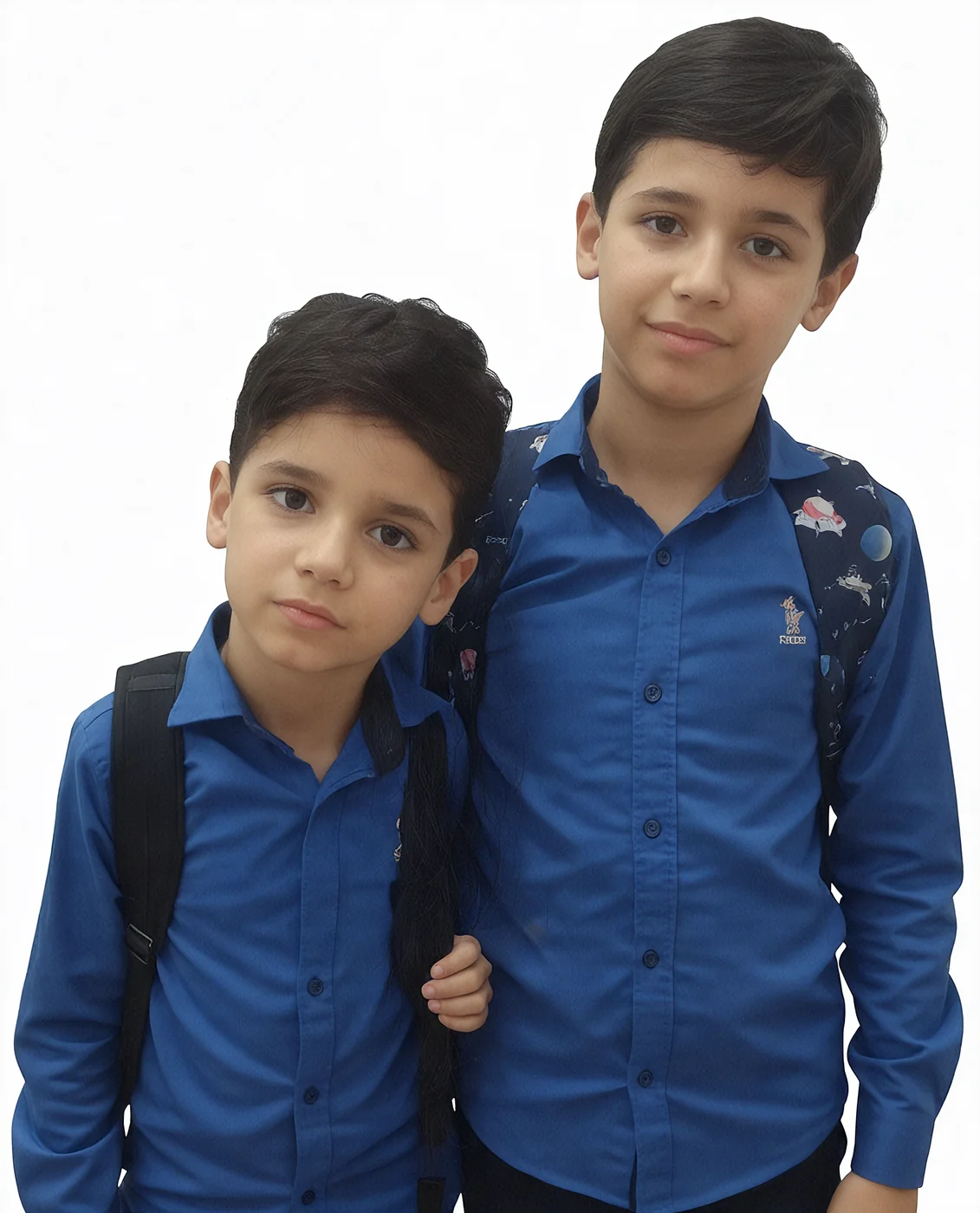
Amirali and Amirmohammad Boostani were two brothers. Amirali was in fourth grade, and Amirmohammad was in second grade. They went to school hand in hand, and they left this world together. Now, only a broken father and mother remain, and a house filled with silence.
“I had only these two sons,” their father says with grief. These days, in their absence, he keeps himself alive by looking again and again at their photos and videos.
He remembers that cursed Saturday morning:
“My sons loved playing football. Their life was playing with a ball. Amirali was in fourth grade and had a special love for epic poetry. My Amirmohammad was in second grade and wanted to become a Football player.
Every day, I took the children to school by myself. Amirmohammad always found it harder to wake up. That morning too, he was sleepy and woke up with difficulty. The time for prayer had passed, but both of them made ablution for prayer. Amirali told me, ‘Daddy, close the window so the sun cannot be seen, so my prayer will not be late.’ I smiled and said, ‘All right.’
Then, when my wife put their snacks into their bags, Amirali said, ‘Mom, I am fasting. Even if you put snacks in, I will not eat them.’ My ten-year-old son kept his word and flew away while fasting. After the attack, when Amirali’s bag was found, not a drop from the water bottle or any of his food had been touched.”
His father speaks of the final goodbye with a lump in his throat:
“When they got out of the car, Amirali said, ‘Daddy, come earlier than 12 today to pick us up.’ I did go earlier, but what a going it became. Our house is close to the school, but no one called us. I do not know; maybe there was no time. Maybe it was destiny.
Around 11, when the school was bombed, my wife ran barefoot toward the school. I rushed there from work. At first, we could not believe it. We thought maybe they had hit the Shahid Absalan clinic near the school. But when we went closer, we saw that no; they had hit the school classrooms themselves. That was when our house was destroyed.
We were among the first people to arrive. We saw some students outside the school and told ourselves our children must also be outside. But that hope disappeared very quickly. My wife sat for hours in front of the rubble and saw with her own eyes how pieces of children were being pulled out from under it.
She had a lump in her throat. She took out a piece of paper from under her chador and gave it to me. She said, ‘Take it. It is Amirmohammad’s school report card.’ When I saw that piece of paper, I felt as if it were my son’s record of deeds, stamped with martyrdom. I asked where she had found it. She said, ‘As I was sitting facing the rubble, the wind brought it from the school to me.’ It was truly strange.
Amirmohammad’s teacher, Mrs. Zohreh Shahriari, who was six months pregnant, was also martyred beside the children.
I went with the rescue teams toward the rubble. With my own hands, I moved stones and metal bars and called my sons’ names. Only one thing came to my mind: Karbala. The mourning stories had become visible before my eyes. I kept whispering to myself: ‘I have lost a flower; I am searching for him.’
Around 2:30 in the afternoon, they struck the school again with several more missiles. Even a mother in the corner of the schoolyard was martyred by one of those missiles. My wife was so shocked that she did not want to move away from the rubble. She said, ‘Let them fire missiles and let me die. I will not return home without my sons.’
The cursed enemy bombed the school several times with missiles, and we saw it with our own eyes. I do not know why some people do not want to believe that the attack on Minab was intentional. How can they claim such advanced equipment and still call this a mistake?”
The body of the younger son was found first, but Amirali remained missing for several days. His mother still hoped that Amirali might have left the school, because many of his classmates had survived. But his father says he was sure Amirali had been martyred.
“I knew the two brothers would not separate from each other. They kept the promise they had made to me, and they went together.”
Then he continues:
“My older son Amirali’s body was more intact compared with his classmates, but may I die for my Amirmohammad, who was torn apart. When they pulled his body out from under the rubble and I saw his fragile, torn body, I could not stand up. I remembered Imam Hussein when Ali Akbar was martyred in Karbala and they said, ‘O youth of Bani Hashim, come and carry Ali to the tent.’ I had no strength to stand. It was as if my back broke at that moment. I turned to the young men of Minab and said, ‘My son has been found. Take his body.’
At that moment, I said loudly to the people: ‘This is my son. This is my eight-year-old Amirmohammad. May he be sacrificed on the path of Ali Asghar of Imam Hussein.’ And I repeated it several times.”
Their father, a member of the mosque board and a constant servant of the mourning gatherings for Imam Hussein, says:
“For twenty years, I have had the honor of serving in the gathering of Imam Hussein. Because of that, my sons grew up in those gatherings from childhood. They were always beside me at the ceremonies of Imam Hussein. Now the only thing that calms me is weeping for the martyrs of Karbala. Sharing grief with them gives me peace.”
Their mother still has not come to terms with the loss and speaks little. But when the Quran recitation of her sons is mentioned, she breaks her silence:
“My children slept every night with the recitation of Surah al-Waqi‘ah. My younger son, Amirmohammad, had a special love for the tenth verse of that surah: ‘And the Foremost Ones are the foremost ones.’ He asked many times about the meaning of that verse. I would explain it to him in a child’s language and say: it means those who do good deeds are ahead of everyone. They are closer to God. You too can be among the foremost in life by doing good.”
Their mother was right. Her sons became among the foremost, and God took them to Himself.
Their father adds:
“For some time, my Amirmohammad had been saying that he wanted to know the meanings of the Quranic verses. We explained them to him. To memorize a surah, it was enough to play the recitation once or twice. In less than twenty minutes, they could recite the entire surah by heart. They wanted to be guests on the Mahfel program and were regular viewers of Hosseiniyeh Moalla. I think it was one day before their martyrdom that the Mahfel program, before iftar, spoke about the martyrs of the twelve-day war. Their faces were wet with tears.”
Mohsen Boostani, the father of martyrs Amirali and Amirmohammad, also speaks of a spiritual experience at the graves of the unknown martyrs in Rostam County:
“We are from Fars Province, from Nourabad Mamasani, but because of my work we lived in Minab. A few weeks ago, on a Friday evening, out of longing for the boys, my wife and I took refuge at the graves of the unknown martyrs in our hometown, Rostam County. We took with us two artificial flowers that had been left in the car for about four months. We sat there and asked the martyrs to pray for the restless hearts of the families of Minab. The grief of losing a child breaks the back.
The next day, my sister called and said she had seen a strange dream. In her dream, two unknown martyrs had covered the graves of my sons with flowers, as if a large tent had been raised over them. In the dream, the unknown martyrs told her: ‘We are the unknown martyrs, and we want to cover the graves of these two martyrs with flowers so the sun will not trouble them.’
My sister did not know that we had gone to the graves of the unknown martyrs. Hearing that dream gave our hearts a little peace.”
One week later, the parents went again to visit those same martyrs, and something strange happened. Their father says:
“The second time we went to the graves of those two unknown martyrs, my mother dreamed that the two martyrs brought the photos of Amirali and Amirmohammad in two frames and placed them in front of our house. They said: ‘We came to be your guests, but the door was closed. So we said we would place the children’s photos on the wall and leave.’”
With eyes wet with tears, the father then speaks of the two flowers he had taken to the graves:
“Before the children’s martyrdom, one day an unknown martyr was supposed to be brought to Shajareh Tayyebeh School for the students to honor. The boys asked me the night before to buy two flowers. It was late, and the flower shops were closed. The boys became upset. My wife suggested that they take two artificial flowers I had once bought for her as a gift and offer them to the unknown martyr. The next morning, the boys went to school with the flowers, but when they got out of the car, they forgot to take them. I also did not realize the flowers had been left in the car.
But perhaps there was wisdom in that forgetting. Those flowers were the same ones their mother and I placed one month after their martyrdom on the graves of the unknown martyrs.
I believe with all my heart in the Quranic verse that says the martyrs are alive and receive sustenance from their Lord. I am certain my sons are alive and affect our lives. I know they see the state of me and their mother and pray for peace in our hearts.
But I am not telling the story of my children to seek pity. The wound of Minab must show the world the innocence of Iran and the evil of the American-Zionist enemy, and it must be recorded in history.”