Chapter 1
The Road to Minab
The road to Minab did not begin in the morning when the missiles fell. It began years earlier, in the slow destruction of diplomacy, in the repeated use of sanctions as pressure, in the language of regime change, and in the normalization of threats against a sovereign country.
Iran and the United States had already seen that diplomacy was possible. The Joint Comprehensive Plan of Action, known as the JCPOA, was endorsed by the United Nations Security Council through Resolution 2231 in July 2015. The Security Council described the agreement as a fundamental shift in the handling of Iran’s nuclear issue and a path toward a new relationship with Iran. Lawful negotiation had worked before, while coercion repeatedly deepened mistrust and weakened those inside Iran who argued for engagement rather than confrontation.
That path was broken in 2018, when President Donald Trump withdrew the United States from the JCPOA and reimposed sanctions. The U.S. Treasury later described the reimposition of sanctions lifted under the JCPOA, including a major sanctions action in November 2018 targeting hundreds of individuals, entities, aircraft, and vessels. (OFAC) Iran, according to later IAEA reporting, began reducing its JCPOA commitments only from 8 May 2019, one year after the U.S. withdrawal. (IAEA) The result was not peace. It was pressure without trust, diplomacy without credibility, and a society forced to carry the human cost of geopolitical punishment.
The United Nations Charter is clear. Article 2(4) says that “All Members shall refrain in their international relations from the threat or use of force against the territorial integrity or political independence of any state, or in any other manner inconsistent with the Purposes of the United Nations“. The Charter does not allow a powerful state to bomb another country because it dislikes its government, wants to reshape its politics, or claims to be helping protesters. The lawful paths are negotiation, mediation, Security Council authorization, and self-defense against an armed attack. Outside those narrow grounds, military aggression is illegal.
The pressure did not remain limited to sanctions. It also appeared in the open encouragement of unrest, the language of regime change, and the shameless suggestion that foreign intelligence actors could walk beside Iranian protesters. On January 2, 2026, Former U.S. Secretary of State & CIA Director__, __Mike Pompeo, posted on X: “The Iranian regime is in trouble. Bringing in mercenaries is its last best hope. Riots in dozens of cities and the Basij under siege — Mashed, Tehran, Zahedan. Next stop: Baluchistan. 47 years of this regime; POTUS 47. Coincidence? Happy New Year to every Iranian in the streets. Also to every Mossad agent walking beside them…”
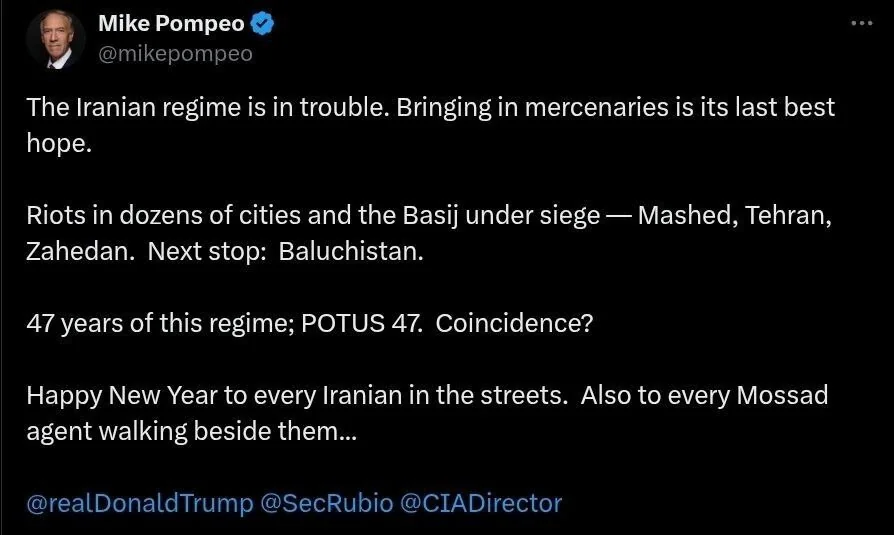
He referred to riots in several cities, named Baluchistan as the “next stop,” and even sent greetings to “every Mossad agent walking beside” Iranians in the streets. Such language was not the language of human rights. It was the language of interference, spoken by a former head of the CIA with an astonishing lack of shame. It clearly shows their hands behind all unitability issues from Baluchistan to Kurdistan. For Iran, this was not an unfamiliar pattern. When the United States seeks to force another country into submission, internal unrest often becomes a tool of pressure. Iran had already seen this clearly in 1953, when the CIA and British intelligence helped overthrow the popular prime minister, Dr. Mohammad Mossadegh, after he nationalized Iran’s oil. Declassified U.S. records later confirmed the planning and implementation of Operation TPAJAX (often referred to as Operation Ajax). The road to Minab therefore passed not only through sanctions and military threats, but also through a long history of using internal division, covert pressure, and political destabilization against the Iranian people.
Netanyahu had been preparing the language of confrontation with Iran for decades. For more than thirty years, he repeatedly presented Iran as an urgent existential threat, often using the nuclear issue as the public frame for a much broader political project. In recent years, that project became more explicit: not only pressure on Iran’s nuclear program, but the weakening, destabilization, and possible collapse of the Iranian state itself. For such a project, he could hardly have found a more suitable partner than Donald Trump. Shortly before the war on Iran, Trump had already shown in Venezuela how easily he could dress imperial greed in the language of law enforcement. After the U.S. capture of Nicolás Maduro, Trump openly said:
“We’re going to be taking out a tremendous amount of wealth out of the ground, and that wealth is going to the people of Venezuela and people from outside of Venezuela that used to be in Venezuela, and it goes also to the United States of America in the form of reimbursement for the damages caused by that country,”
This was not the language of democracy. It was the language of extraction. It showed the same old imperial instinct: first call another government illegitimate, then use force, then speak of resources. In Iran, Netanyahu’s long obsession and Trump’s appetite for domination met each other. The result was this mad war: a war born from malice, greed, and the belief that powerful men can set fire to other nations and then call the ashes strategy.
This is why the war that led to Minab cannot be separated from the years before it. Sanctions weakened ordinary life. Threats replaced diplomacy. Regime-change language intensified fear. Military force was presented as an option before peaceful remedies were exhausted. The attack on Iran was therefore not an isolated event; it was the final step in a long pattern of coercion.
And then the cost of that pattern reached the school. Minab was not a military theory. It was not a speech, a sanction list, or a strategic map. It was a city with families, teachers, and children. When Shajareh Tayyebeh School was struck, the abstract language of power became concrete: desks, books, dust, blood, and parents searching for names.
The illegality of the war matters because illegal wars do not remain illegal only at the border. Once the first unlawful missile is launched, every civilian death that follows carries the weight of that original crime. A school destroyed in such a war is not an accident floating outside of history. It is the human consequence of a decision to replace the law with force.
One of the people this chapter is about
