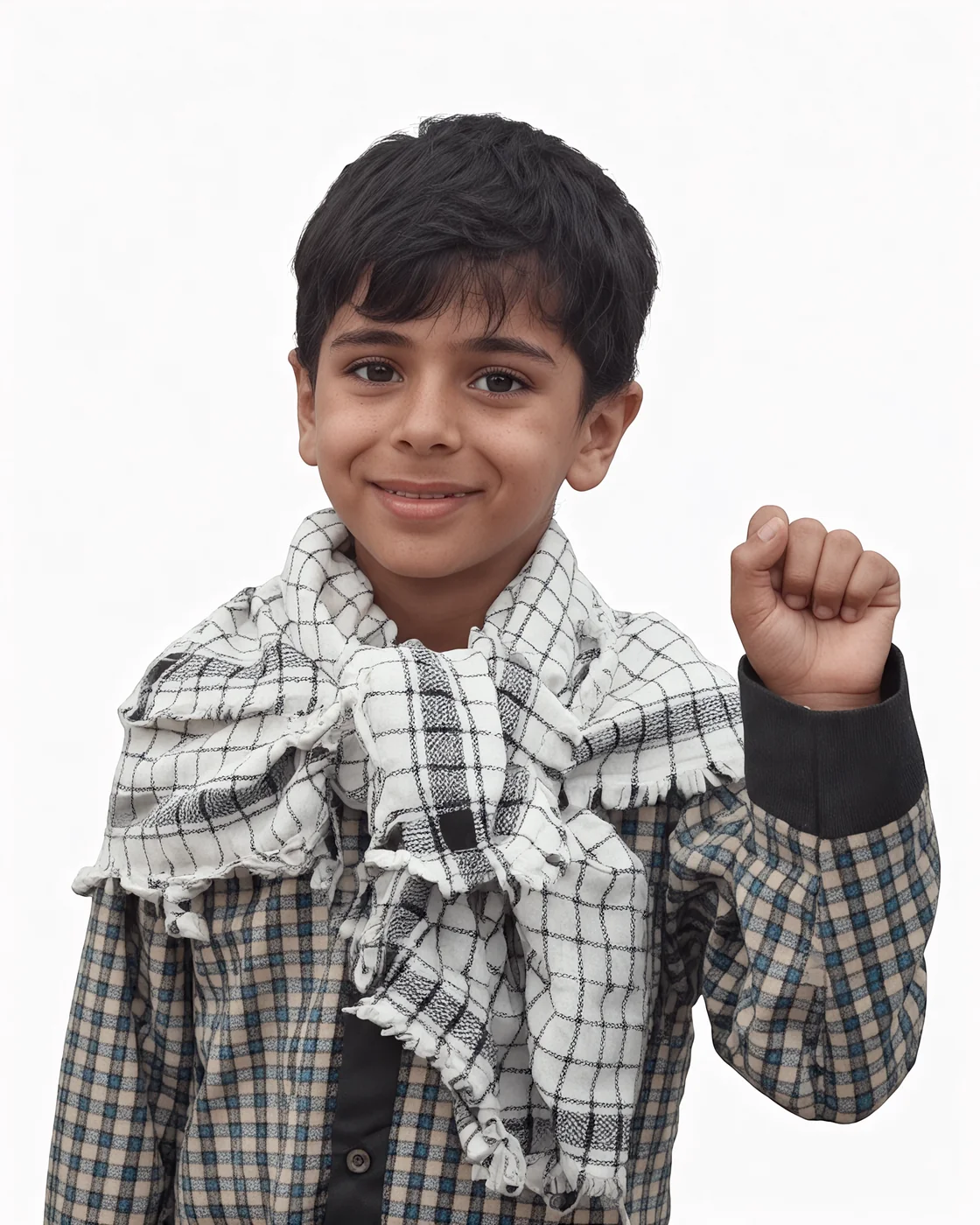
Soheil Chamalipour was a second-grade student. His eighth birthday would have been on March 2, but the American missile did not give him or his family the chance to celebrate it.
His mother, Zahra Monazzeh, a midwifery expert, says, “I think Soheil was born again in heaven.”
She shows his notebook. In answer to the question, “What would you do if you had two wings?” Soheil had written: “I would fly and go to Mashhad.”
He loved Imam Reza very much. His mother says that every year he waited for the next trip to Mashhad. Whenever they went, he would tell his father to lift him onto his shoulders so his hand could reach the shrine.
Now his grieving mother says, “Do not think I was only his mother. I was more his friend. He did not look at me only as a mother. Soheil was my friend.”
She says that the night before his martyrdom, Soheil’s sister, Manian, had not written her homework and was crying in a strange way. It was unusual. She would not let Soheil write his homework either. She threw away his books, scribbled over his homework, and in the end both children went to sleep without finishing their assignments.
At five in the morning, Soheil woke up for the pre-dawn meal and told his mother, “Mom, come help me write my homework quickly.” But Manian did not wake up. In the morning, no matter how much her mother tried to wake her and send her to school, she refused to go.
Soheil’s last homework was to write a sentence about Iran. He wrote: “I love Iran.”
His mother says, “Every day I dressed him myself, but that day, because he had football, he quickly put on his clothes, wore his shoes, and left. I kissed him and took him to class.”
At 11:16, the earth shook.
Zahra Monazzeh was examining pregnant women when the sound of the explosion broke the silence of the clinic. At first, they thought it was a truck. But the thick smoke rising from the direction of the school cried out the terrifying truth.
She says, “There was heavy traffic on the way. I saw a woman crying and saying they were pulling the hands and feet of children out from under the school rubble. I lost my mind. I left the car in the middle of the street and ran.”
What Soheil’s mother saw at the school was beyond endurance. “When I looked toward Soheil’s classroom, I saw only rubble. There was no classroom anymore.”
Desperate and helpless, she moved through dust and blood, crying, “Soheil, where are you?” She had only one wish: “I wanted to move the earth away with my own hands, even with my nails, and find some trace of my child.”
Pieces of victims’ bodies and the silence of the morgue left hope and despair fighting inside the family. Rumors spread: perhaps someone had taken the child away; perhaps he was still alive. But the truth was waiting in the morgue.
One week after the catastrophe, a DNA test and a phone call from the physical education teacher revealed the truth. His mother, with a voice that still trembles, remembers the final meeting: “The first pure body I saw was the body of my little boy, Soheil. He had been struck in the head, and his skull had opened.”
They took Soheil, washed him, shrouded him, and carried him on his final journey to Behesht-e Zahra.
At the end of this burning story, his grieving mother has no complaint, no cry left, except one wish: “I wish to reach my child myself as soon as possible.”