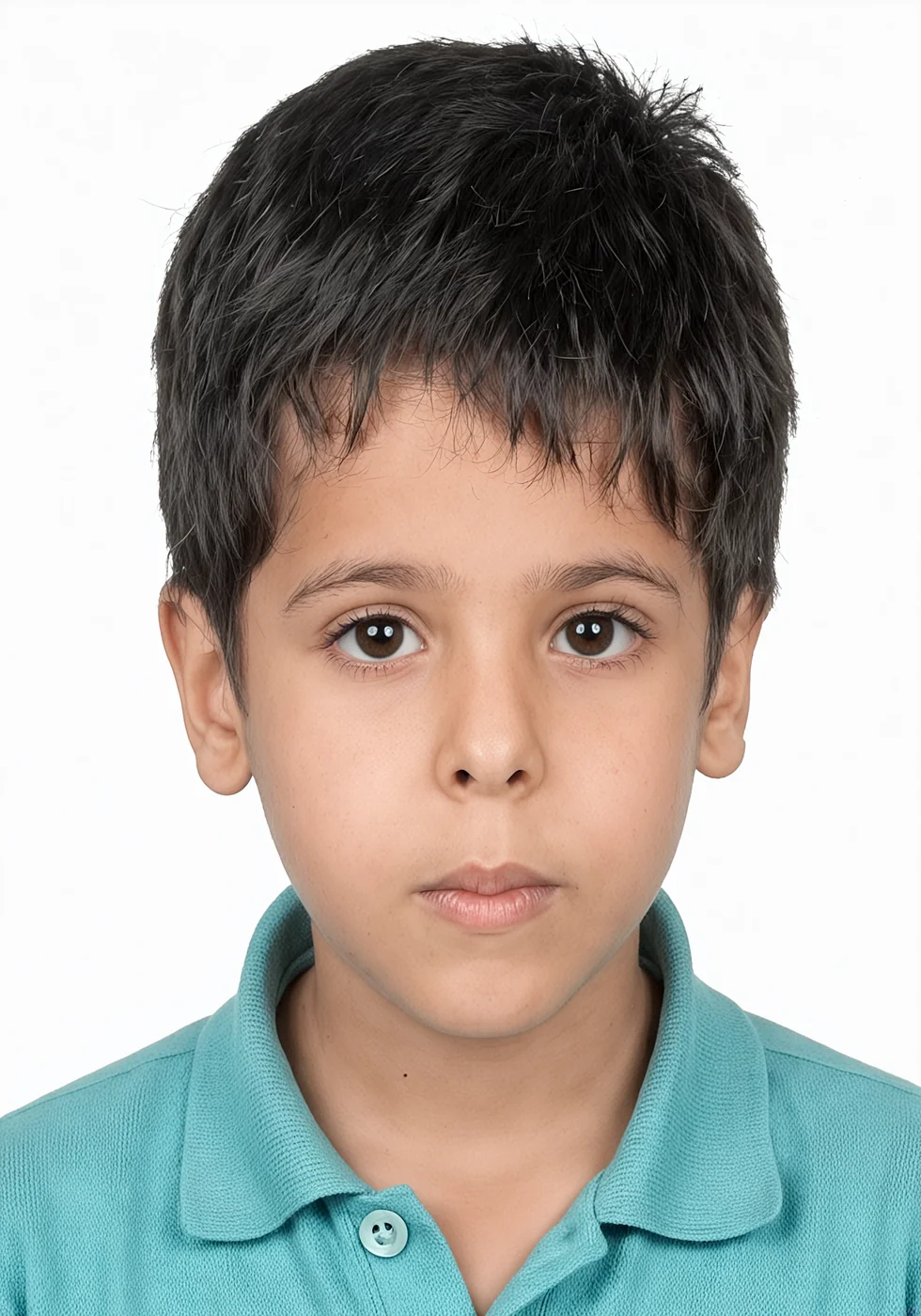
Sina Zakeri Gourzangi was a fourth-grade student.
Mrs. Atefeh Zakeri Gourzangi, a primary school teacher, speaks of the day of the attack:
“The boys’ schoolyard had been destroyed. I went toward it to look for Sina, my nephew. I thought he must have escaped. I thought surely, I would see Sina in the boys’ yard, because our Sina was very quick, very intelligent.
I looked across the entire boys’ yard and saw no boys. I did not see any of my colleagues either. I saw a few boys being put into cars and taken away. I saw the sixth-grade teacher and asked, ‘Where are the boys? Were they saved? Did the boys come out?’
She said, ‘I was only able to save my own students.’
The sixth, third, and fifth-grade boys’ classes were in the hallway and were not connected to the main building. They had been able to come out. But the boys who were inside the building were trapped under the rubble.”
With grief, she says:
“I sat facing the boys’ school and only stared at the rubble. I kept saying, ‘Sina is under the rubble. My nephew is under the rubble.’
Mrs. Naderi came down, took my hand, and said, ‘Come, Atefeh, let’s go.’
I said, ‘I cannot. Sina is not here. Sina is under the rubble. My colleagues, the students…’
She was pulling my hand, as if she could not hear what I was saying. She did not understand my words. She only kept pulling my hand to take me with her.
She took me out of school. In the alley, a driver saw us. He put us in his car and took us to the hospital.
There was a student in the car whose eye had been injured. He asked, ‘Teacher, why can’t I see with my left eye?’ I did not know what to say.
We went to the hospital. One of my students, whom I had saved, had burns on his body and neck. He kept saying, ‘Mrs. Zakeri, please be well. You brought me out. You saved me. Nothing should happen to you.’
But my heart, my mind, all my thoughts were still at the school. I was thinking only of Sina. I was thinking only of the students and my colleagues.
I was at the hospital when they said the hospital had to be evacuated because it might have been hit too. We went into the yard. It was very crowded. Suddenly they said the school had been struck again.
On Monday afternoon, we found Sina’s body in the morgue.”
Akbar Zakeri, Sina’s father, speaks of the last morning of his son’s life with a voice burning from deep within:
“Sina was the fruit of my life. That day, it was as if everything was different. He did not have school transport, and his mother insisted that I take him myself. We always joked on the way to school, but that day Sina was anxious. He was in a strange state, as if he had been suddenly inspired. How could I know this would be the last time I would see his small figure in the car mirror?”
He pauses, then continues with a lump in his throat:
“What sin had these children committed? Sina loved studying. He always said, ‘Dad, I want to become a doctor so I can serve my own people here in Minab.’ He wanted to be a cure for pain, not to become an incurable pain in our hearts.”
His father recalls the moment of the catastrophe, the moment when the news of the bombing fell on him like a hammer:
“It was around 11. I was at the office when the sound of the explosion came. When I heard they had hit the school, I ran like a madman toward the school building. The girls were upstairs and the boys were downstairs. The missile had hit exactly in the middle of their classroom. The two-story school had been leveled to the ground. People were removing the rubble, but the number of martyrs was so high that everyone’s back was bent with grief.”
He remembers the moment when fear and crime became one:
“While we were searching for the children, another drone came and struck about twenty meters away. People scattered. His mother and I no longer had the strength to stand. We returned home, but we had neither the strength to stay nor the courage to go and see our son’s torn body beneath all those stones and debris.”
The following days became a hell of waiting and uncertainty for the Zakeri family.
Zakeri says:
“His body could not be found. They said some of the bodies had been taken to Shahid Mohammadi Hospital in Bandar Abbas. When I arrived, they said several burned bodies had been brought there and could not be identified.
Right there, on the cold floor of the hospital, I sat down and cried out: ‘Sina, my son, where are you? Show yourself to me… Give me a sign, just one sign, my son…’”
His tears begin to fall.
“The morgue had three large halls, full of the small bodies of girls and boys. Their faces were all burned. My wife’s brother found a body that looked like Sina. I went closer: a burned face, two broken legs; clothes turned to ash, and two fingers that were no longer there.
I still doubted it. I opened his mouth. On the right side, he had a tooth that had been extracted before. At that moment, the whole world collapsed on me.
It was him.
His mother came too and confirmed it. Our Sina was no longer breathing.”
Now, what remains of Sina is a house where every corner hurts.
His father says:
“Sina was my friend. We always talked heart to heart. Now, when I pass by his English language institute and see the other children, my legs become weak.
When I go into his room, his whiteboard is still there, the one he used to practice math on. His English books are there. The stationery he had bought with joy is still there.
Everything is there.
But where is their owner?”