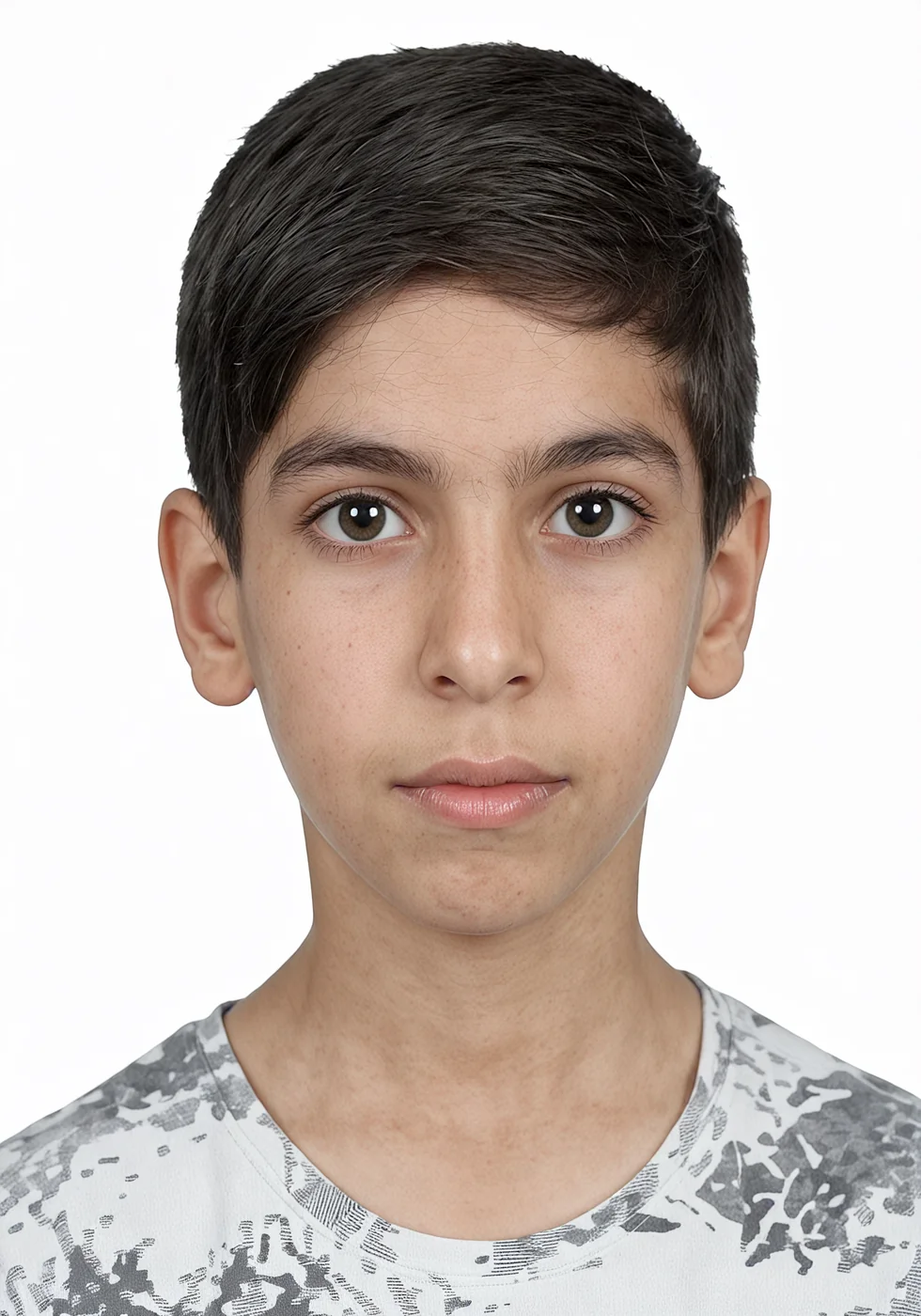
Mohammad Loghmani Abdan was a fourth-grade student.
His mother tells of the final days of her son’s life and the bitter moments of finding his body among the ruins of the school; a story that brought both tears and silence to those who heard it.
Mohammad was only 10 years old, but his mother says he understood far beyond his age. He was so wise and calm that sometimes she felt she could even entrust him with her final wishes.
Somayeh Eghtedari, Mohammad’s mother, speaks of her son with a grief that is still fresh: Mohammad loved the Quran very much. He always carried a digital Quran pen with him and took it to school so the other children could use it too. If I could not find him in the alley, I would become worried, but he always told me, “Mom, whenever you do not see me, come to the mosque. I am always there.”
The mosque was Mohammad’s constant refuge; even his childhood games were played in its courtyard.
A few days before the attack, his mother had decided to go to Karbala for Nowruz. His younger sister objected, but Mohammad said something else. He brought all the snacks his mother had prepared for him and placed them in front of her: “Mom, take these for the road to Karbala. You can eat them on the way.”
His mother says that in the days before the attack, her heart was filled with strange unease. She felt something was coming. She spoke often with her children about death, the hereafter, heaven, and hell, and Mohammad listened eagerly.
The night before the attack, Mohammad asked his mother to read the Persian translation of the Quran to them, like a bedtime story.
His mother says: Mohammad and his sister Reyhaneh lay down on their beds. I was reading Surah al-Rahman to them and speaking about heaven. Suddenly Mohammad asked, “Mom, if we die, will we miss you and Dad in the next world?” I told him no; God removes all longing from the hearts of those in heaven.
On Saturday morning, around 11 o’clock, the phone rang. It was Mrs. Raheleh Ranjbar, Mohammad’s teacher; the same teacher who was herself martyred. She said, “Come to the school. It is closed. Come and take Mohammad.”
The road from home to school was only a few minutes. Mohammad’s mother took her little daughter with her and left. Before she reached the school, the sound of the explosion brought the whole world down upon her.
“I turned and looked,” she says. “I saw the missile hit Mohammad’s school directly, exactly where his classroom was.”
At that moment, she cried out only one sentence: “O Imam Mahdi, I give my Mohammad to you.”
When she arrived, nothing there looked like a school anymore.
There was dust, smoke, collapsed walls, broken columns, and mothers fallen to the ground in every corner. The left side of the school was gone. Mohammad’s classroom no longer existed. Only two columns remained, and a ceiling that had fallen crookedly over the rubble.
Mohammad’s mother searched for her son in that hell. Beside a burned car, she saw pieces of a student’s body, including a hand burned so badly that at first she thought it was a doll. Then she realized it was a child’s hand.
She says God gave them a strange strength in that moment. She did not scream. She did not complain. She only waited for Mohammad to be brought out from under the rubble. But until evening, there was no news.
The next day, among burned bags and shoes, she found Mohammad’s school bag, half-burned, with a piece of his trousers and part of the bone of his leg attached to it. There, she understood that Mohammad no longer had legs.
For four full days, she went back and forth between home and the morgue.
On the fourth day, after the morning prayer, she prayed for Imam Mahdi and asked for only one thing: that Mohammad be found.
That day, she found her son herself.
Nothing remained of his face, his legs, or even his head. Only one hand was intact, the hand whose nails she herself had cut.
“I recognized him by that hand,” she says.
Then she falls silent, and after a moment says quietly: “That night, when I was reciting Ziyarat Ashura and thinking of Lady Zainab, I could not understand her. But the next morning, in that school, among the rubble, I understood what Karbala means. I said to myself: I wanted to go to Karbala. Karbala is here.”
Mohammad always said he wanted to become famous. He wanted to invent something. He wanted his Quran to remain as a keepsake.
Now his name remains, not only in a photograph at home, but in the memory of a city that has not forgotten the smell of smoke from the school. And whenever his mother opens the Quran, it is as if she still hears Mohammad’s voice saying, “Mom, read from my Quran.”
The story of Mohammad Loghmani’s mother is not only the grief of one family. It is the story of a generation that flew away innocent, and with its blood revealed the truth of the enemies of humanity. Mohammad left, but the sound of his Quran recitation, the trace of his steps in the mosque, and his childlike dreams of a blessed end remained in his mother’s heart and in the memory of this land.
Perhaps Karbala is not only a place on a map. Sometimes it is here, among the ruins of a school, in the hands of a mother who recognizes her child by his nails.