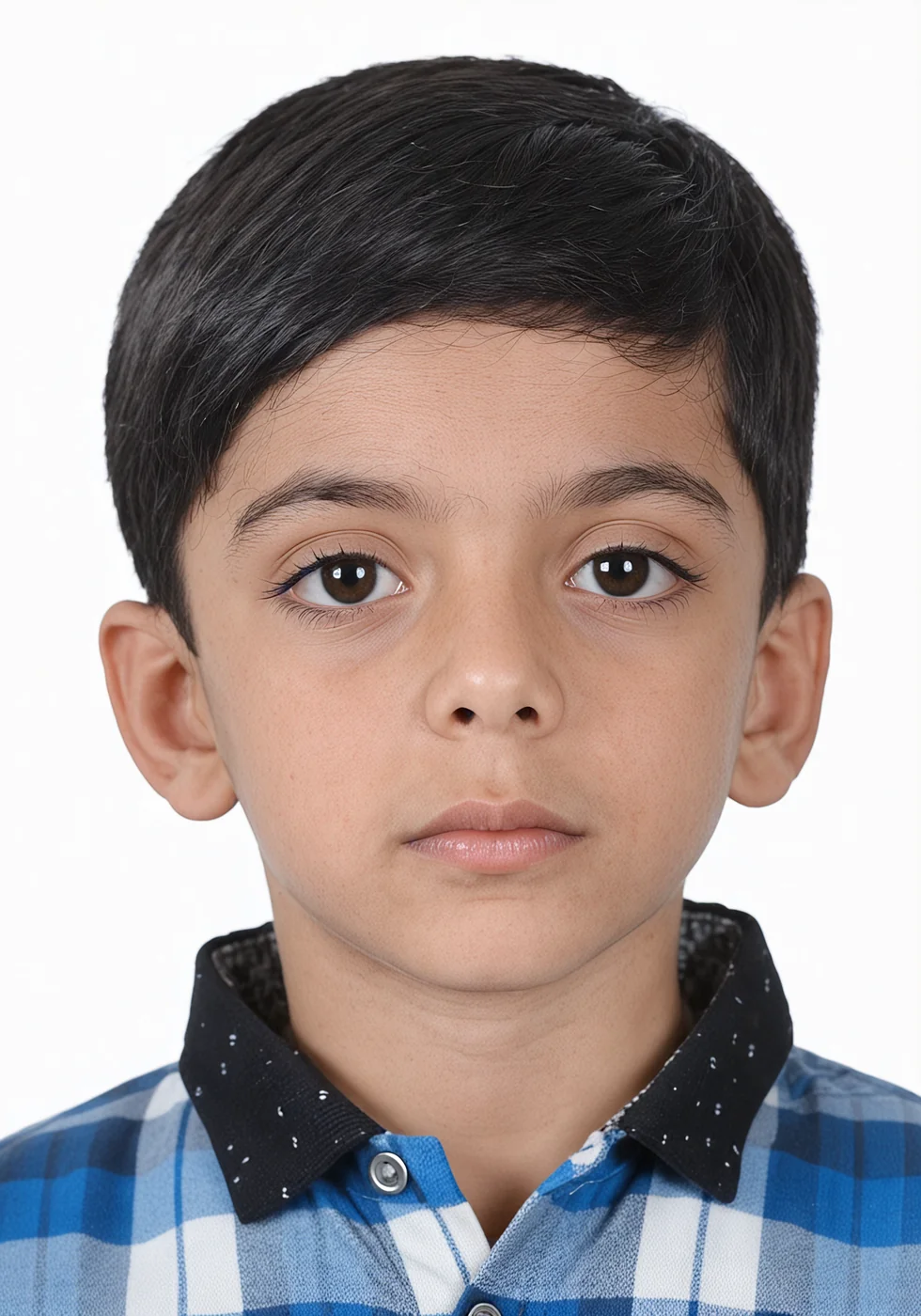
Mohammad Abadizadeh was in fourth grade. He was nine years old.
His father says Mohammad had great dreams. He wanted to become the Minister of Economy. He wanted to be someone who could have an impact on society and solve its problems. He was hardworking, tireless, and full of effort.
His mother, addressing America and Israel, says: “You cannot reduce even a particle of our faith with these crimes.” She says Mohammad had memorized parts of the Quran and worked very hard for it.
With tearful eyes, Mohammad’s father says:
“When I arrived at the school, I still hoped that perhaps my Mohammad was alive under the rubble. Like every father and mother there, I kept saying, ‘Mohammad, don’t be afraid, my son. I am here. Don’t be afraid. The fire truck, the crane, and the loader will come, and we will help you.’
At the same time, I saw a mother asking everyone, ‘Have you seen my daughter? She had a pink scarf, pink shoes, she was this tall, and her bag was red.’ She asked everyone she reached, then went back and, with her own hands, removed rubble and bricks from the dust.”
This continued until four in the afternoon, when loaders and heavy machinery removed the main mass of rubble and reached the bodies.
“When we reached the classroom of the first-grade girls, we saw scenes that words cannot describe. Poor little children had been crushed under the weight of columns and the heat of the missiles. Their innocent bodies were pulled out one by one from under the rubble, placed in body bags, and sent to Minab hospital.
Because the roads were blocked by the crowd, I saw fathers and mothers running on foot through the trees behind the school to reach the hospital, hoping to identify their children.”
Mohammad’s father continues:
“They were transferring the bodies to refrigerated trucks, and I, like everyone else, searched among them in disbelief, looking for my Mohammad. When I say ‘body,’ do not imagine something like an ordinary dead body. These two-ton missiles, made to destroy concrete bunkers deep underground, had left almost nothing of the children’s bodies. The teachers, who were adults, had been reduced to the size of a small, swaddled infant.
By then, we were certain that no one would call us ‘Dad’ anymore. We were only looking for a sign that might calm our hearts.”
On the third day, they said identification was almost complete. But there were bodies with no heads, no hands, no waists; only fragments remained.
Mohammad’s father says that from the day Mohammad was born, he had been a blessing in their home: kind, caring, and compassionate, like the other martyrs of Shajareh Tayyebeh School. He remembers taking Mohammad to visit Imam Hussein’s shrine when he was six years old. When Mohammad saw the dome, he placed his hand respectfully on his chest and said, “I have heard that visiting with dusty clothes brings greater reward.” His father says that perhaps Mohammad received his share of martyrdom there.
As Ramadan approached, Mohammad insisted on fasting. On the morning of the attack, his mother combed his hair and saw him off at the door. It was their last meeting.
“The enemy was afraid of these children,” his father says.
He then speaks of the terrible condition of identification at the hospital:
“I went with my two brothers to identify him. At first, they showed us a martyr and said it was Mohammad. But when I looked carefully, I saw that it was not my Mohammad. The bodies were so destroyed that even close family members made mistakes. The father of martyr Heydar Salehi faced the same difficulty in identifying his child.
On the fourth day, my heart still had no peace. I returned to the morgue. The person in charge said that in that section there had only remained that could not be identified at all. I begged and went inside.
I looked inside the body bags. There were the hands, feet, and burned and crushed remains of our children. In all that loneliness, I saw Mohammad’s foot and recognized it.
From all of Mohammad’s body, only one foot was left for me to accept as ‘Mohammad.’
I did not know how to tell this to a mother who had not eaten, drunk, or slept for four days, waiting for news of her child.”
Mohammad’s father says that some time later, on the fortieth day, they found a handwritten note from Mohammad addressed to Imam Mahdi. With his small hands, Mohammad had written:
“In the name of God.
Dear Mahdi, all pains will be healed only by your coming. Come, for the world is sick without you. There is only one path of salvation left, and that is your bright reappearance. The world is on the edge of destruction, and human beings are hopeless and broken-hearted.
Peace be upon you, promised savior. Dear Mahdi, the sky and the earth are full of pain. It is as if the flowers, the trees, and the butterflies have forgotten joy.”