Mikaeil Mirdoraghi was a third-grade student.
Eleven hours before the deadly morning of Saturday, February 28, he drew that picture: a white sheet from a spiral sketchbook, showing the school building, the Iranian flag above it, five children in the schoolyard, and three missiles falling toward them.
Two sentences were written in the sky above the school: “The children died” and “military forces.” Mikaeil had misspelled the Persian words for “children” and “military” on the last night of his life. Had the bombs not reached Shajareh Tayyebeh School in Minab at 10:45 on the morning of Saturday, February 28, the first day of that horrifying war, his teacher, Razieh Zamani, would surely have seen those sentences and corrected them for him. But her body, too, was torn apart.
Mikaeil’s family is originally from Andimeshk. They had moved to Minab because of his father’s job. His mother, Shakiba Derikvand, as she herself says, searched for her son “alone,” “far from home,” with “no one there to hold her hand.” On the road from home to school, while the whole city seemed to tremble beneath her feet, she fainted several times. In the end, she found him in a refrigerated truck: his face covered in blood, his body intact, and his school backpack held in his arms.
His father says Mikaeil loved football. He was especially fond of Alireza Beiranvand, the goalkeeper of Iran’s national team, and he wanted to become the goalkeeper of Iran’s national team one day.
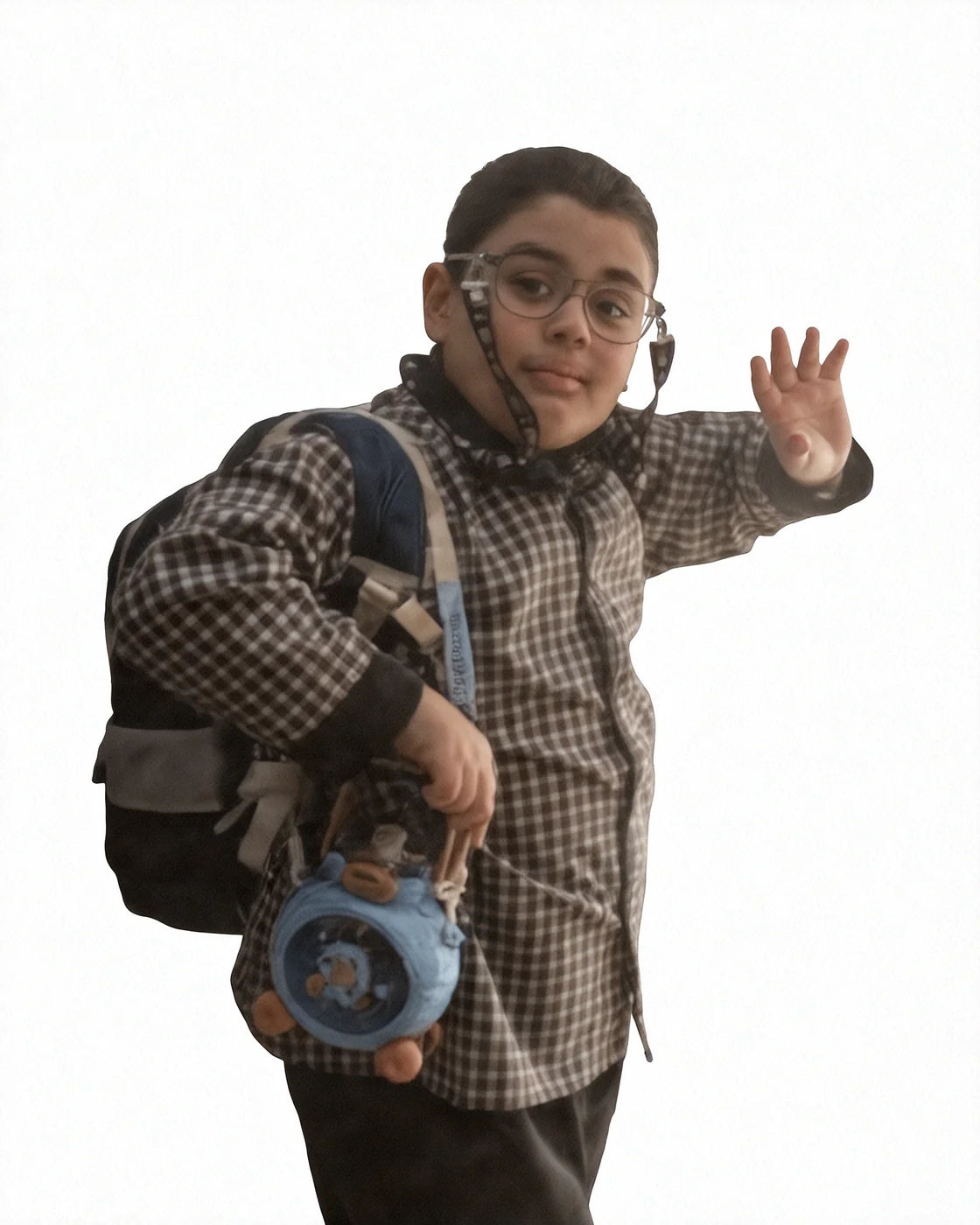
One photograph of Mikaeil remains from the morning of his martyrdom. Before leaving for school, on the stairway of their home, in front of the door, he asked his mother, “Take a picture of me.”
His mother did not know that this would be Mikaeil’s last photograph.