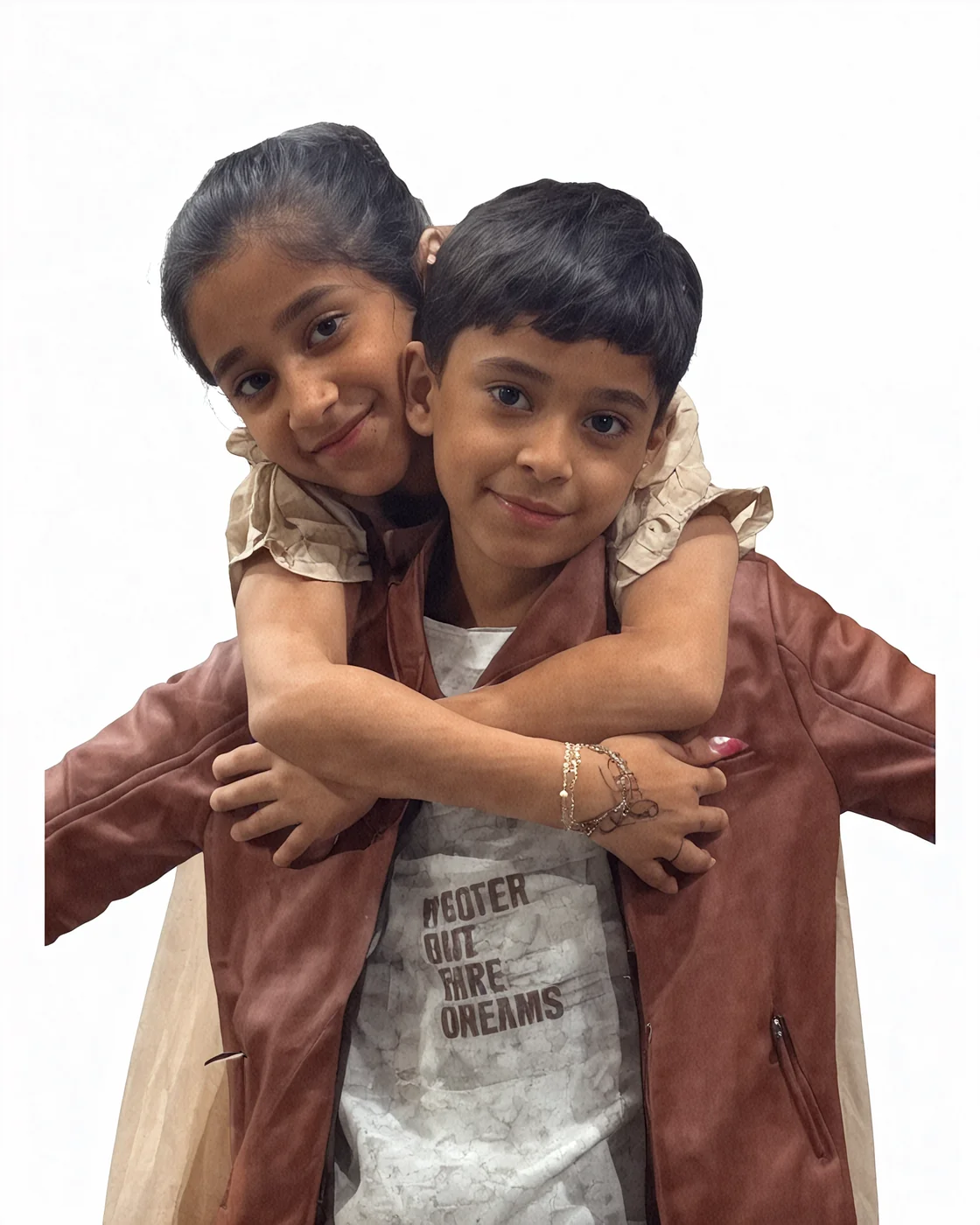
Ali Salari was in first grade, and Mahya was in third grade. They were martyred together with their mother.
Their father, Hassan Salari, says:
“On the last night I was home, we spoke until late. We made plans for our future, for our life, and for the children. We loved each other very much. But sadly, the years of our happiness were very short.”
Hassan was a carpenter and worked in a city far from Minab. At the time of the attack, he had not been home for about a week. He was supposed to return a few days later to be with his family. But the deadly explosions of that terrible day forever separated his hands from the hands of his wife and children.
The only survivor of the Salari family says:
“My wife had gone to pick up the children that day. Most likely, as usual, she entered through the back door first and told Mahya to come downstairs so they could return home with her brother Ali. But death reached them first. She had probably not taken even ten steps when the first missile struck. She and my poor little son were buried under the rubble. Mahya, too, was thrown from the upper floor by the explosions and buried among the ruins of the building.”
He was at work that day. At first, he was told that the clinic beside the school had been hit. After several hours, he learned that the school itself had been bombed. He kept calling his wife, but her phone was unreachable. Later, when he finally spoke to his brother, he was told that his car was buried under rubble in the schoolyard. Only then did he understand that the school had been directly attacked and that his wife and children were probably inside.
“My brother kept saying the situation was terrible. They were pulling pieces of children’s bodies from under the rubble. Still, I could not believe that my wife and children could be among them.”
When he reached the school and entered from the boys’ side, all his hopes collapsed.
“Until that moment, I imagined the children might be trapped somewhere under the rubble, waiting for someone to rescue them. But when I saw the scene, I understood. The rubble was flattened against the ground. There was no air, no opening, no place where anyone could breathe or struggle. I told myself that my children and my wife must be beneath those stones and dust.”
Both of his children’s teachers were also martyred.
On the second day of searching, the Red Crescent workers found two parts of his wife’s body, a foot and a hand, together with one hand of his son Ali. He identified his wife with her wedding ring, still in her hand.
“What remained of my son was found on his mother’s body. His colored pencil case was still with him. Half of it was burned. The pencils inside were Ali’s; we had written his name and stuck it on each one. I feel Ali and his mother were very close to the point of impact, because their bodies were burned and almost nothing remained of them.”
On the afternoon of the third day, he found Mahya, his third lost one, in the morgue. He identified her with the bracelet and ring on her hand.
“To reach Mahya, I passed through two halls full of bodies. I saw at least ninety body bags before I reached my daughter. But many were not whole bodies anymore. Some were only pieces of innocent children. I searched among bones, fingers, and fragments, hoping to find Mahya’s ring on her hand.”
At the far end of the morgue, he saw several bodies placed together. He opened the first cover.
“The first thing I saw was Mahya’s hand—the same hand with her bracelet and ring. To be sure it had not been mixed with another body, I compared the bracelet and the ring with the photos I had of her. It was her. It was my daughter Mahya’s hand.”
From Ali, a video remains. His little hands are dirty, and he tells his mother, “Look, I am fixing Mahya’s bicycle.”
Ali cared deeply about keeping secrets. If he made a mistake, he did not like anyone outside the family to know.
In Ali’s drawing notebook, some drawings affected his father deeply: one of his teachers, drawn with the exact color of her clothes, and another of their family of four, drawn in pencil and still uncolored.
“For me, the most beautiful portrait of our family is that drawing Ali made. Sadly, the time we had together was very short.”
Mahya was more like her mother. She even had the same dimple on her cheek. She was small, emotional, and had a beautiful father-daughter bond with him.
Ali expressed his feelings more openly, while Mahya liked to write for her father. She had recently learned to make omelets and was very proud of it. She would say, “Daddy, now I can make breakfast for myself and Ali.”
On Father’s Day, with her small hands, Mahya had written on a piece of paper: “My dear Daddy, Happy Father’s Day.” Sometimes she drew hearts. On one of them, she had written: “Father, my whole existence.”
Before he left for work, she would sometimes make small envelopes, draw on them, and secretly put them into his backpack. He now tries to keep the children’s remaining keepsakes with him as much as he can.
Both Mahya and Ali attended Shahnameh recitation classes in the summers, and Mahya had drawn several characters from the Shahnameh. The drawing notebook they had taken to school on the last day was never found. It seems to have burned in the explosions.
The first room in their home is Ali and Mahya’s room. Their clothes, empty beds, dolls, and toys are still there before their father’s eyes. Seeing them now makes the absence even heavier.
“I hope God has mercy on us, the fathers and mothers of Minab,” he says.
The empty place of his wife and children remains an unanswered question in his heart. He still does not know why such a thing had to happen to their innocent children.
He remembers how he and his wife first came to know one another through her aunt, who was their neighbor. Before marriage, they had no relationship, but each had quietly carried a good feeling for the other and had prayed, without saying anything, that they would marry. After their proposal and marriage, when they spoke openly, they realized how mutual and simultaneous that feeling had been.
Their happiness had begun with a quiet prayer. It ended under the rubble of a school.