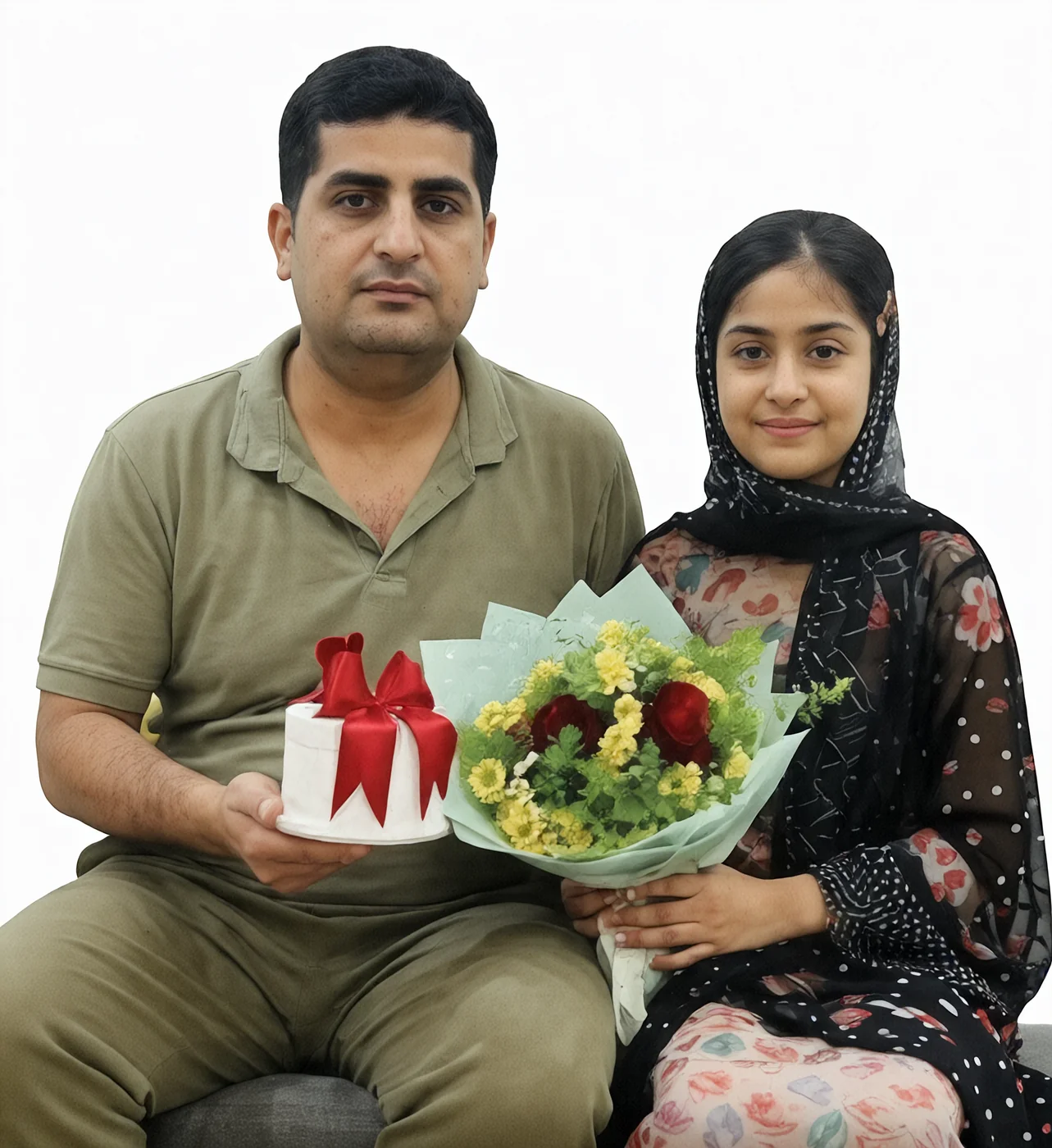
Sonar Salari was a fourth-grade student. She was martyred together with her father, Hamid Salari. Her father had gone to the school to bring her home, but fate was that they would leave this world together.
Sonar’s mother, who now has only Sonar’s sister left, says that Sonar deeply loved studying lessons and the Quran. She dreamed of becoming a doctor one day. Whenever Sonar learned a new lesson, she would record her voice and send it to her mother.
Speaking of the day of the attack, her mother says:
“Around 11 o’clock, they called me and told me to come for Sonar. I called her father, Hamid, so he would go and get her. A few minutes later, when I heard that the school had been hit, I rushed toward the school.
On the way, I saw a number of wounded students. I thought perhaps my Sonar had also been injured. I could not believe at all that she had been martyred.
There, I kept saying, ‘Call Hamid. Tell him to come so we can find Sonar.’ I did not know that Hamid himself was under the rubble.
Two hours later, I saw Hamid’s car in front of the school. I said, ‘That is Hamid’s car, but he is not here.’ Only then did I understand that Hamid had also been martyred.”
After the tragedy, the surviving members of the Salari family traveled to Mashhad: Sonar’s grandmother, cousin, sister, and mother. Beside Sonar’s grandmother stood several teenage girls. One of them was Sonar’s cousin, Zahra Rotani. She was only twelve years old, but it seemed as if in just a few days she had grown much older.
Rotani is the name of a village in Minab. With her strong southern accent, Zahra introduced herself. She described the day of the attack:
“That day I was at home and had not gone to school. Suddenly, there were three terrifying sounds. We saw smoke rising from the direction of the school. We quickly got into the car and went toward the school.
Everything had been destroyed.
My other cousin and I kept calling, ‘Sonar, Sonar,’ but there was no answer. We went to the hospital, and until night they kept saying Sonar might be in the ICU, or the operating room, or another ward. Each time, we ran to see if she was alive. But that same night, they told us Sonar might have been martyred.”
At this point, tears overtake her. From behind, where other members of Sonar’s family are standing, quiet sobs can be heard. Even without going to Minab, one can hear the living lament of that tragedy in Mashhad from the voice of twelve-year-old Zahra.
With her beautiful eyes filled with tears, she continues:
“They said they would show us photographs of the martyrs so we could identify them. Sonar was the forty-eighth photo they showed us. Then we were supposed to go for identification. I recognized her by her bracelets and earrings, but I still doubted whether it was really her. I told my aunt, and she said, ‘It is her.’”
Zahra’s tears grow heavier when she speaks about Sonar’s absence during the visit to the shrine:
“Sonar and I were like sisters. Now that she is not here, I feel lonely and very sad. I wished she were beside me in the shrine too, so we could visit together.”